Physics is a wonderful way for people to understand the world around them. It can explain how birds fly, why ice freezes, what makes fire glow, just to mention a few things. Now, this doesn’t meant that the explanations are always easy and clear. In fact, the explanations can be downright murky for phenomena far from the familiar. Perhaps the two physics theories that are the hardest to accept when you first encounter them are Einstein’s theory of relativity and quantum mechanics. The first one talks about how moving clocks run more slowly than stationary ones and how objects in motion appear to shrink. The second one tells us that no measurement is certain and that probability reigns supreme in the subatomic world.
While I’d like to tell you that there is some credible debate about these theories and that scientists have somehow figured out a way to return to the more intuitive physics of the late 1800s, but that isn’t true. The simple fact is that relativity and quantum mechanics have been tested countless times and they work. Like it or not, we have to learn to accept these weird predictions are just, simply, well, true. However- and this might blow your mind- these ideas are also about a hundred years old. Frontier science has actually moved on. What scientists currently think is even weirder still.
So let’s review a bit what traditional quantum mechanics is all about. It was invented in the mid 1920s and it was exemplified by an equation devised by Erwin Schrodinger, what we now call Schrodinger’s equation. This equation explained why electrons had only certain energies and positions when they circled an atom.
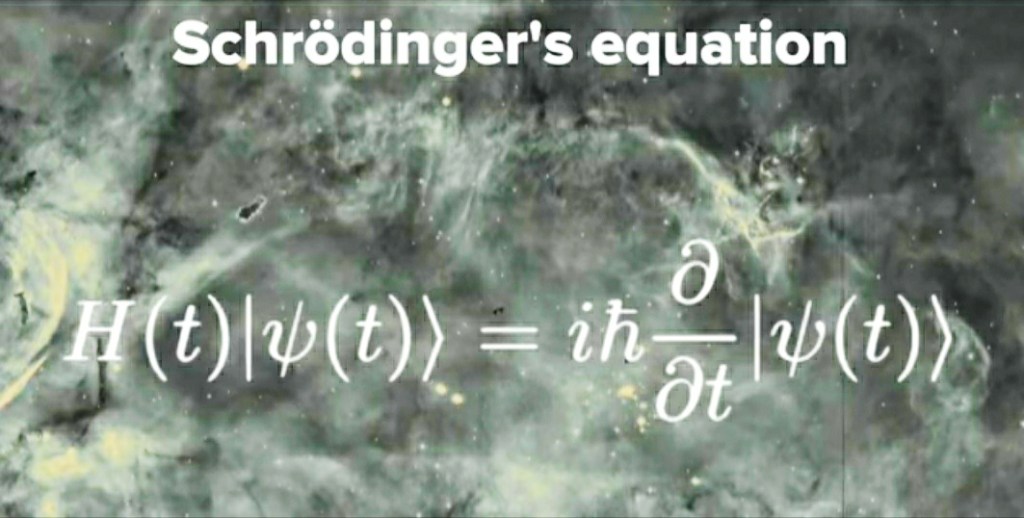
At its very simplest, the equation explained that an electron could be here or there, but never here nor there (see the figs. given below).
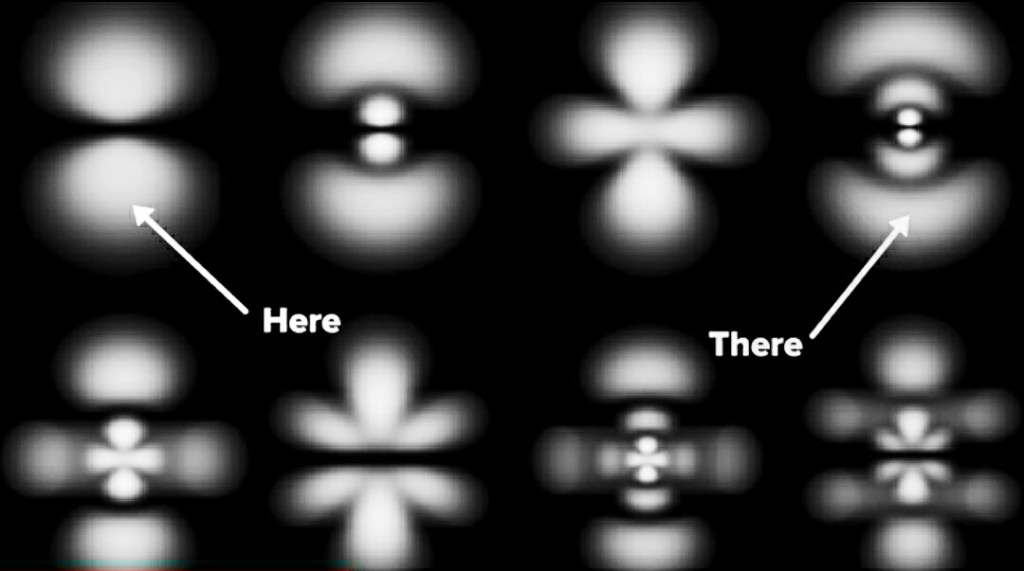
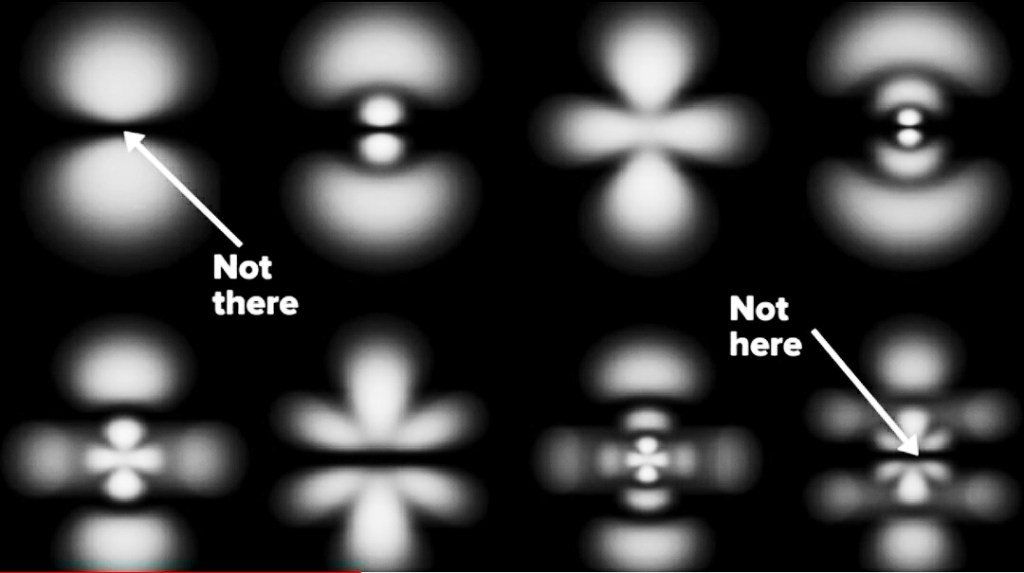
That’s what “quantum” means. There are certain, discrete things that are possible and others that aren’t. The things that were quantized could be mass, charge, position or energy. Now, Schrodinger’s equation was only a partial quantum theory and it didn’t take into account relativity. What it did was take a proton and assume it was surrounded by a classical electrical field. Remember that classical fields are not quantized. They vary smoothly. However, things changed in the late 1920s when Paul Dirac started puttering around with quantum mechanics. One thing he did was successfully merge quantum mechanics and Einstein’s theory of special relativity.
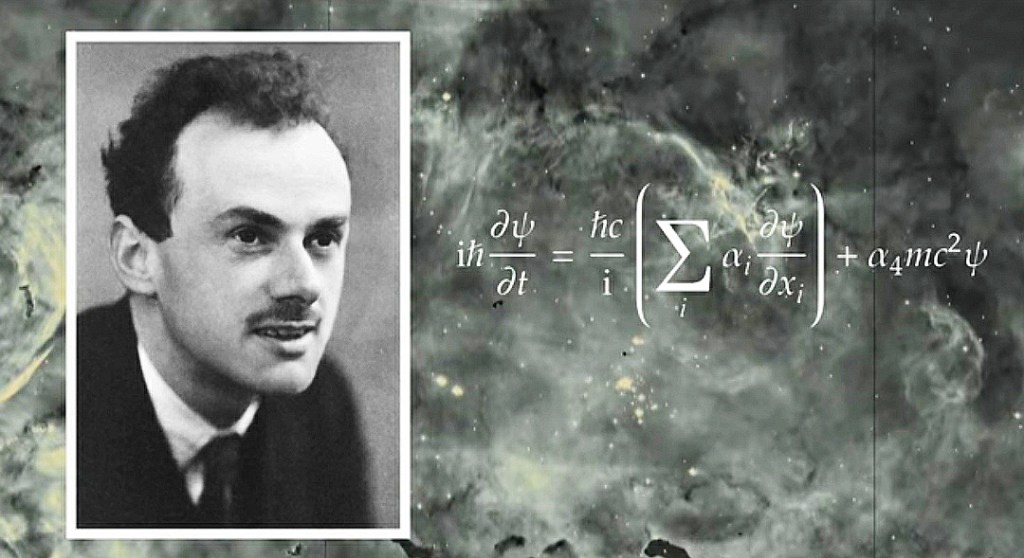
Another thing he spearheaded was to figure out a way to make a fully quantum theory. He did this by finding a quantum formulation of the electric field surrounding the proton. We call this the “second quantization revolution.” This just means that the electric field was expressed quantum mechanically and that it joined such things as a quantum description of the location of matter, which was covered by the first quantum revolution. In the ensuing years, these ideas have been generalized to cover all of the subatomic forces, specifically the strong nuclear force, the weak nuclear force and electromagnetism. While each force has a different precise formulation, they are all examples of what we now call a quantum field theory or QFT. Although each theory has its own interesting peculiarities, I want to talk a little about some general truths of all quantum fields. In modern physics theory, one can picture all subatomic particles as beginning with a field. Then the particles we see are just localized vibrations in the field. So, according to quantum field theory, the right way to think of the subatomic world is that everywhere- and I mean everywhere- there are a myriad of fields. Up quark fields, down quark fields, electron fields, etc. And the particles are just localized vibrations of the fields that are moving around. The idea can also explain how particles interact. For example, suppose you have an electron moving along. The electron is a localized vibration of the electron field. If the electron emits a photon, then the quantum field theory way of looking at things says that some of the energy of the electron field sets up a localized vibration of a photon field which then moves away (as illustrated below).
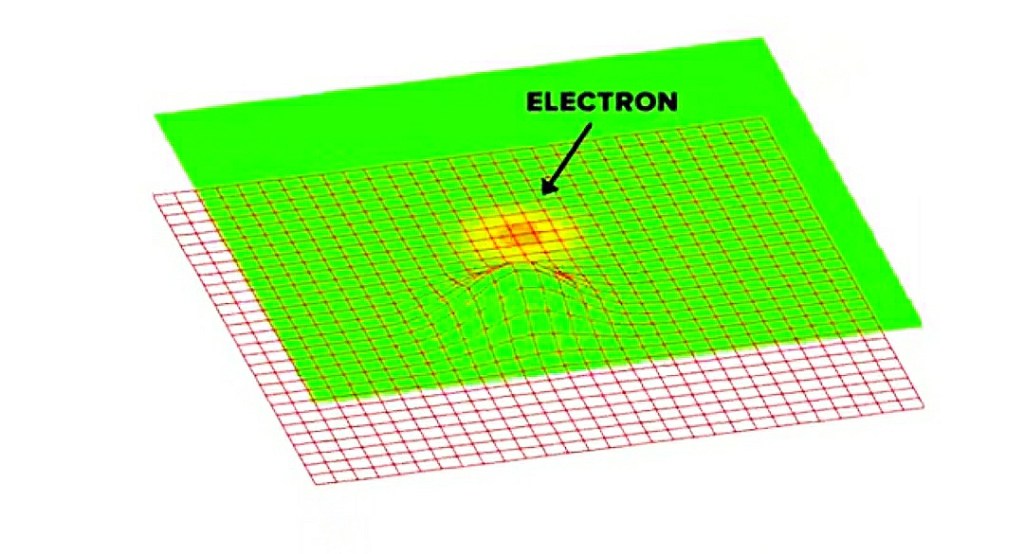
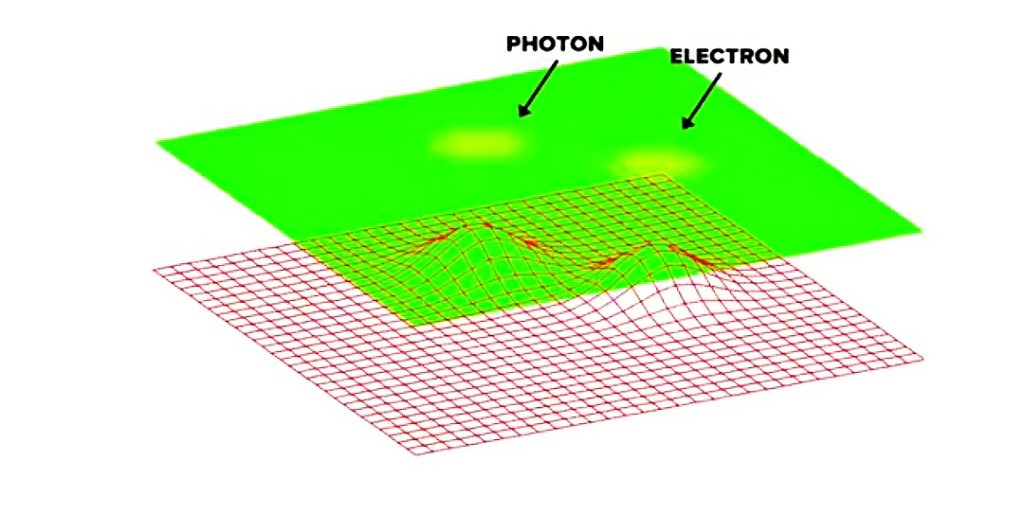
So those are the essential features of quantum field theory. Theoretical physics simply imagines that ordinary space is full of fields for all known subatomic particles and that localized vibrations can be found everywhere. These fields can interact with one another, like two adjacent tuning forks. These interactions explain how particles are created and destroyed- basically the energy of some vibrations move from one field and set up vibrations in another kind of field. Now, of course, actually calculating something with this prescription is really, really very difficult. The math can be pretty crazy. But the basic idea is really very simple. If you look around you and you have even the smallest ability to think creatively, you can imagine these vibrations everywhere you look. I don’t know about you, but I think that’s an awfully cool idea.
 Physics of Everything
Leave a comment