Without a doubt, Einstein’s theory of special relativity makes some mind-blowing prediction. Clocks run at different rates, objects in motion appear to shrink and things can’t go faster than light (300,000km/s). All these things are true. Relativity has been thoroughly tested and there’s no credible criticism of the theory.
So, let’s talk about the last one – the idea that you can’t go faster than light. This is a well demonstrated fast. So why is it true?
If you ask well-educated scientific layperson, they’ll tell you it is because the mass of the object increases as the velocity increases. Infact, you’ll hear this said by people with physics degrees. There’s only one thing. It’s just not true. Now I realize that me saying that is going to confuse a lot of you. So, what’s going on? Why is it that even some physicists say that mass of an object increases as the velocity increases?
So, it starts with the concept of inertia. Inertia is a property of matter which resists changes in motion. At low speed:
Inertia=Mass
At very high speed, it’s no longer true. Mass and inertia are no longer the same things. An effect that didn’t matter before begins to matter a great deal.
If you have ever had a physics class, you’ve encountered a concept called momentum. It has a meaning very similar to colloquial meaning. Colloquially, once something has momentum, it’s hard to stop. In physics, we write momentum using this simple equation:
p=m×v
Here, p stands for momentum, m for mass and v for velocity. So, you can see that momentum increases, as the mass increases or as the velocity increases or both mass and velocity increases. Momentum is related to inertia. Something with a lot of momentum is hard to stop but that could be a slow moving massive train or a very light, but superfast, bullet. That equation and those intuitions are pretty familiar. The problem arises when we start going at speeds that are very fast. At very high speed this equation no longer applies. The correct equation is this one:
p=γ×m×v
Here γ is gamma. So, how these both equations can true? At very low speed gamma is equal to 1. Think about something fast – the fastest cricket ball ever thrown, the gamma is 1 or more specifically this number 1.00000000000001. How about the bullet from a sniper rifle? That’s pretty fast but gamma is still pretty close to 1 i.e; 1.000000000001. Infact, in order to make gamma to be 1% different from 1, which is to say 1.01, you need a velocity so fast that it can circle the Earth at equator in a single second.
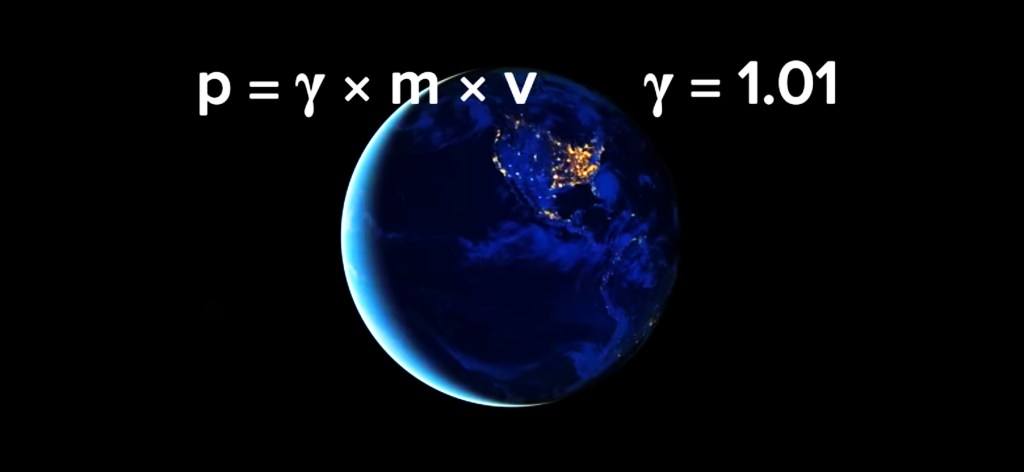
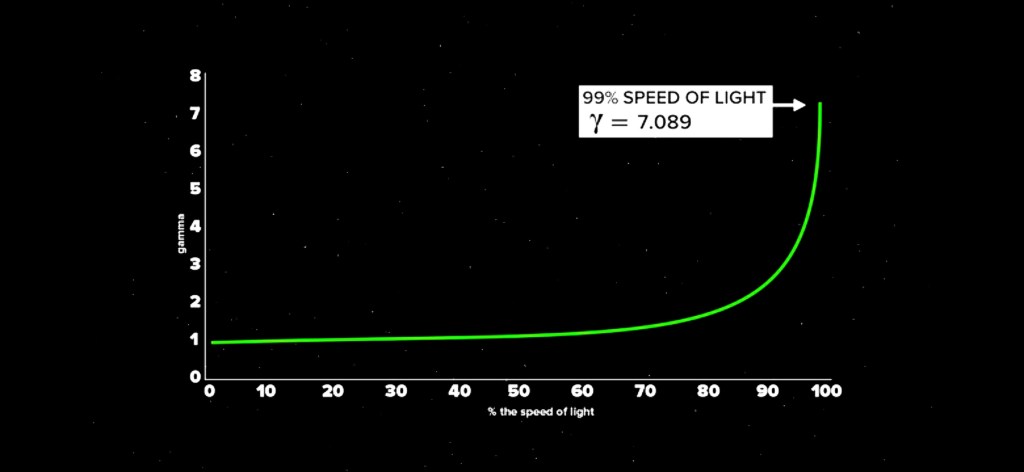
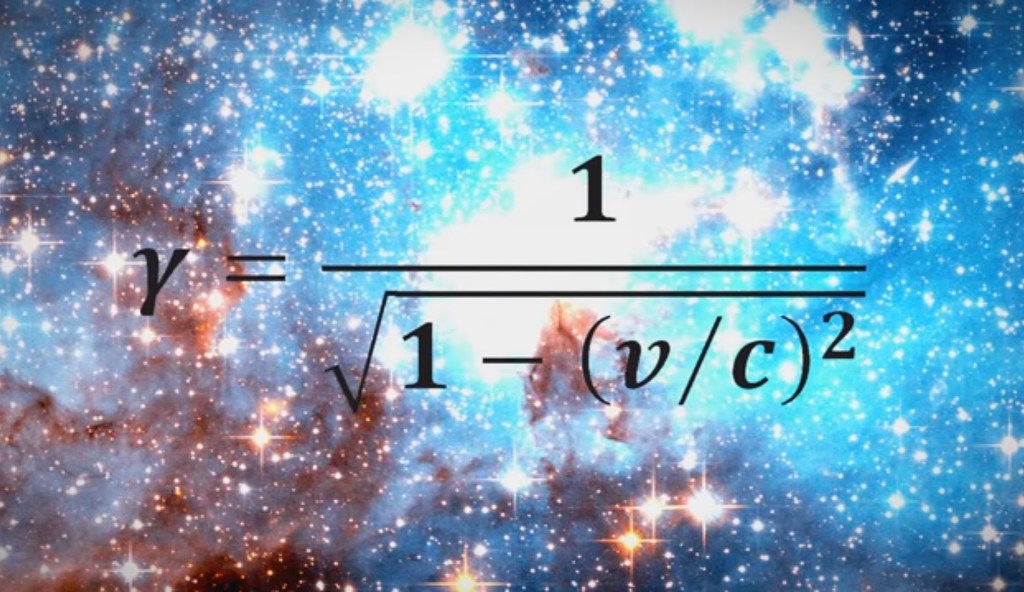
So, in any situation you’ve encountered, the gamma is basically 1 and you can drop it from equation. But when you move at very high speed, you can’t do that anymore. At 10% of speed of light, gamma is about 1.005. At 50% of speed of light, gamma is 1.155 and at 90% of speed of light, gamma is 2.294. When you get to 99% of speed of light, gamma is 7.089. And as you get even closer to speed of light gamma gets bigger and bigger. As you approach the speed of light, gamma becomes infinite.
The equation to calculate gamma is shown below in the picture:
So let’s get back to idea that mass increases as you move faster and faster. How did that arise?
Relativistic mass is just gamma times the actual mass. If you do that, you can write the momentum equation as just:
Momentum=relativistic mass times velocity
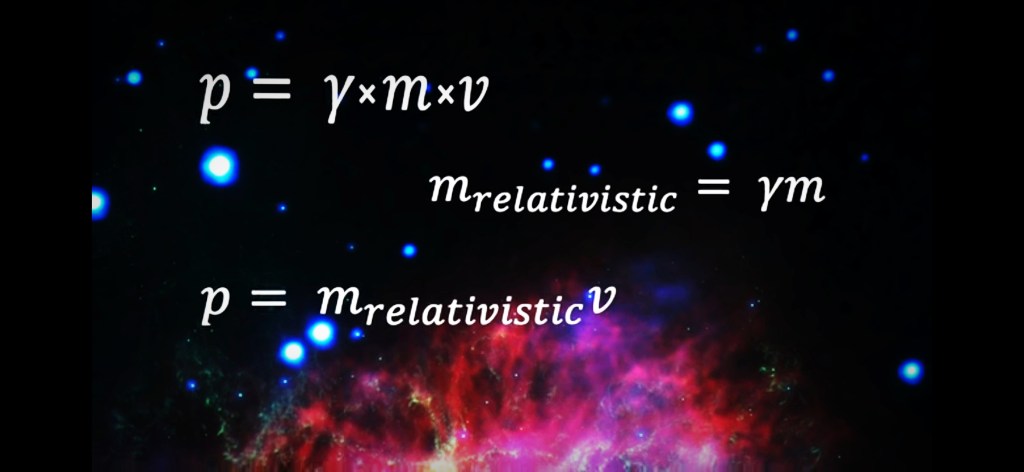
That equation looks just like the introductory momentum equation.
The idea of relativistic mass comes at a price. The price is a misconception. For instance, people might take relativistic mass and Newton’s equations for gravity and come up with some hodgepodge equations (as below) that don’t accurately reflect what’s going on.
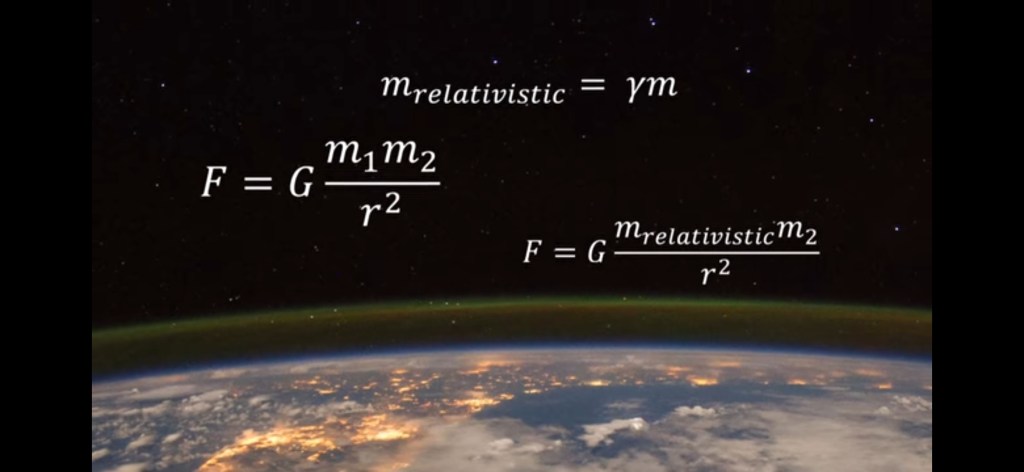
The majority of physicists, who deal with relativistic situations on a daily basis really dislike the concept of relativistic mass. We say that an object has only one mass, which is the mass you measure for an object when it isn’t moving with respect to you. Some people call that the rest mass but it’s really the ONLY mass.
Dig in deeper here: http://arxiv.org/pdf/hep-ph/0602037.pdf
 Physics of Everything
Leave a comment