Scientists studying subatomic particles have found something extraordinary. For the first time, they have seen a particle changing into antiparticle and back again. But why this observation is so unique? Why has it created such hype? And most importantly, how did scientists arrive at this conclusion? Don’t worry I’ll explain it.

Most of you might be wondering what an antiparticle is. Here’s the simple explanation. Everything you see around is made up of Particles. Some of these particles are positively charged such as protons while others are negatively charged such as electrons. An antiparticle is one having similar properties to that of particles but an opposite electric charge. So if a proton is a particle with positive charge its corresponding antiparticle is antiproton with opposite charge (negative charge). Ok! let’s move further. Do you remember starting your chemistry classes with Dalton’s atomic theory? Dalton said that atom was indivisible. It’s the smallest entity. Well now we know it isn’t. An atom is made up of nucleus around which electrons revolve. The nucleus is composed of protons and neutrons which are further made up of particles called quarks. So far, quarks are known to be most fundamental particles of nature that constitutes matter that we see around us. There are six quarks in standard model of Physics. These are 1. Up quark 2. Down quark 3. Charm quark 4. Strange quark 5. Top quark 6. Bottom quark.
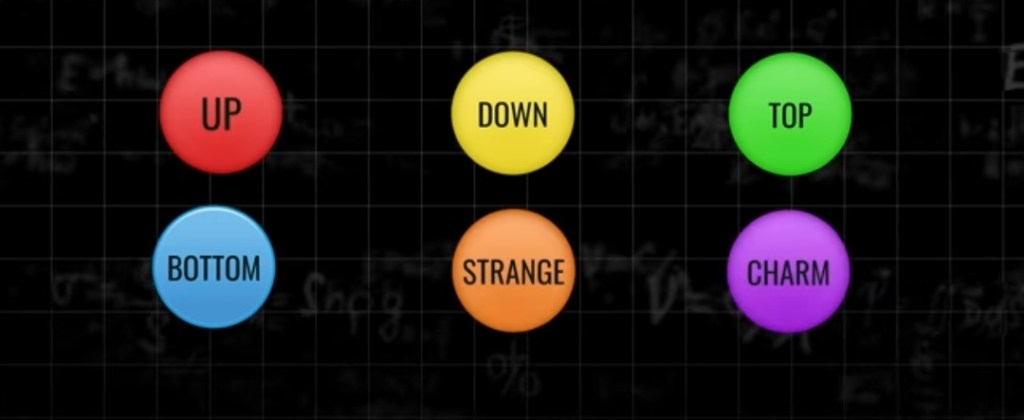
Forget about all quarks except charm quarks. These are ones behind this grand discovery. Different combinations of these quarks make up different particles. For example, some pairs of quarks and antiquarks form a family of Particles called mesons. A meson is a particle made up of quark and an antiquark held together by the strong force. Charm meson is made up of charm quark and anti-up quark. Observations have revealed that the charm meson lives in a state of superposition of being itself and its antiparticle this superposition results in two particles. One being heavier one and other the lighter version of charm mesons, allowing the particle to oscillate into its antiparticle and back again. For ten years, it was known that the charm meson could travel as a mixture of their particle and antiparticle state. However, for the first time, they have been found to oscillate between two states. Furthermore, measurements have shown that these particles differ by 10^(-38) grams. That’s a hundred trillion trillion trillion smaller than a gram. Such a negligible value… isn’t it? But this minute mass difference is critical quantity that controls the speed of a charm meson oscillation into anti charm meson and vice versa.
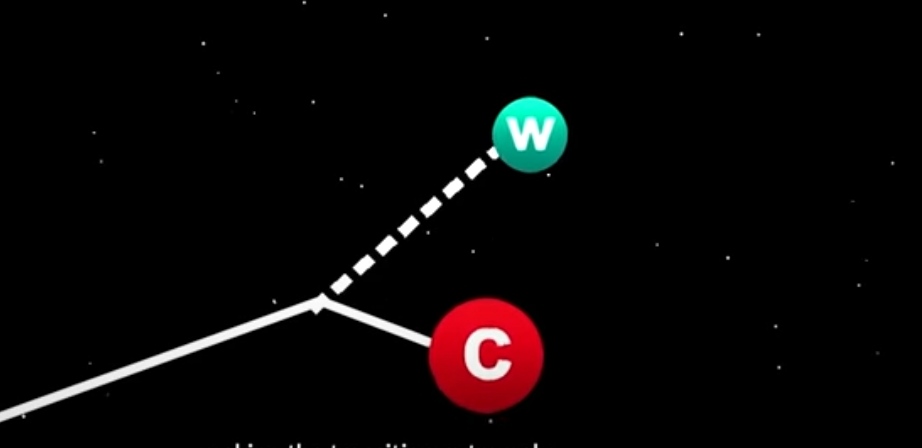
So how was such a tiny quantity measured? Wouldn’t it has been challenging to do so? Well, definitely it was. A measurement of this precision and certainty requires a copious number of observations and even analysis method has to be extremely precise. In laboratory systems, charm meson particles are produced in proton – proton collisions in particle accelerators. Before decaying or transforming into other particles, they travel only few millimeters. The researchers compared charm meson particles that decayed after traveling short distance with those that travel a little further two measure the mass difference between the two classes of particles. Apart from the charm meson, only one particle has been seen to oscillate in this way: The charm beauty meson.
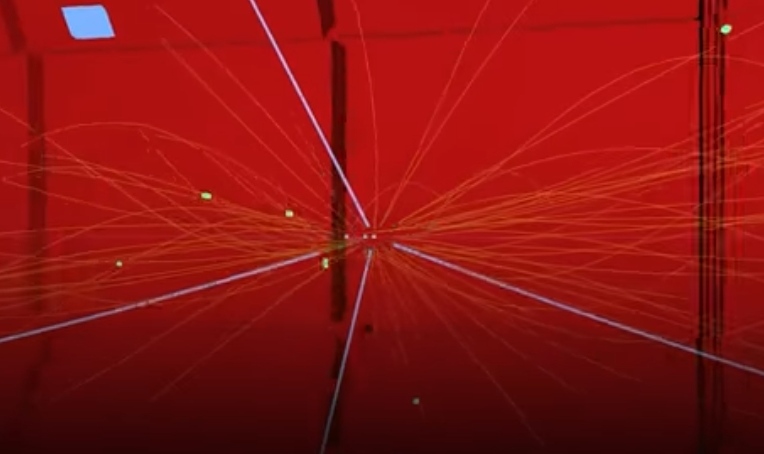
But what makes the discovery impressive, is that in case of charm meson, the oscillation is very slow making transition extremely difficult to be measured. Within short time of 40 picoseconds that the meson takes to decay. This discovery has opened up a new door for particle exploration. It can potentially prove to be a significant step in solving the mystery of matter – antimatter asymmetry or baryon asymmetry and shed some light on why our universe is entirely made up of matter even though matter and antimatter was created in equal amount after the Big Bang.

 Physics of Everything
Leave a comment